
Jeff Kaplan Reveals the CFO Meeting That Broke His Blizzard Career
Why Jeff Kaplan left Blizzard: Overwatch revenue targets and Overwatch League pressure, not lost love. CFO's 1,000-layoff threat forced his exit.
In 2026, the story of why Jeff Kaplan left Blizzard has lost none of its sting. The Overwatch co-creator finally sat down on a podcast and explained the moment that broke him: a meeting in the CFO's office where he was told the game had to hit a redacted revenue target in 2020, then keep hitting a redacted recurring revenue target every year after. If it failed, the company would lay off 1,000 people. And, according to Kaplan, that blood would be on his hands. He called it the biggest f**k you moment of his career. Yeah, that'll do it.
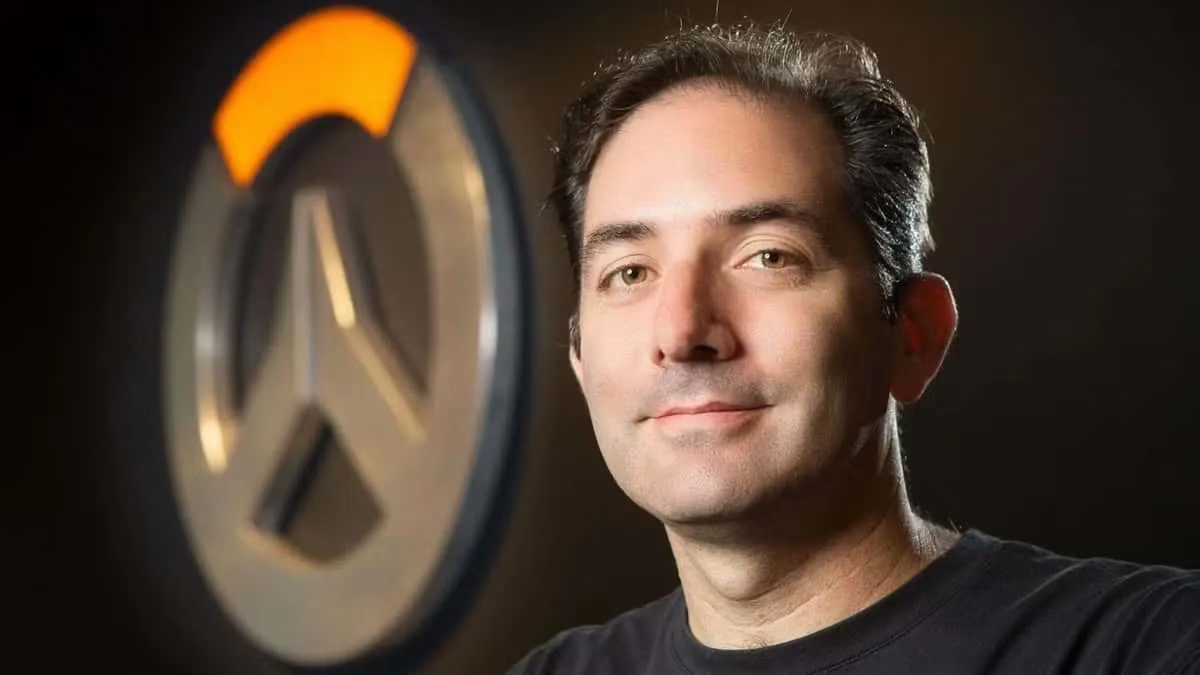
Kaplan did not leave because he stopped loving Overwatch. He left because the game was being asked to carry an entire esports ecosystem on its back like a tired pack mule wearing a jetpack. The Overwatch League launched in 2018 with fireworks, investor hype, and a promise that it would be bigger than the NFL. In reality, it ended in 2023. Between those dates, the league became a black hole for development resources. The game itself was not just a game anymore. It was a revenue machine, a marketing vehicle, and a Twitch integration project all at once.
The CFO's spreadsheet had teeth. Kaplan described how the pressure trickled down: Overwatch League was overmarketed to investors, and Blizzard essentially sold the Brooklyn Bridge. Promises were made that could not be kept. To support the league, the team diverted time and talent into broadcast-friendly features, camera controls, Twitch integration, and a mountain of team skins and uniforms. That sounds simple until one remembers that every skin and uniform needs art, tech, testing, and a pipeline that does not break the rest of the game. Meanwhile, the actual game was left treading water.
That fact is worth letting sink in. The people who wanted new world events, new heroes, and Overwatch 2 were competing with a spreadsheet that wanted recurring revenue yesterday. Kaplan said plans went out the window. The team was not focused on Overwatch 2. They were not building the next big thing. They were keeping the lights on for a league that had been promised the moon and had trouble delivering a stable orbit.
Here is a rough timeline of how the pressure cooked:
| Year | What Happened | The Vibe |
|---|---|---|
| 2018 | Overwatch League launches | Champagne, confetti, and very confident slides |
| 2020 | Kaplan is called into the CFO's office | A date, a number, and 1,000 jobs on the line |
| 2021 | Kaplan leaves Blizzard | The captain jumps before the ship hits the iceberg |
| 2022 | Overwatch 2 launches | A sequel arrives, but the league is already wobbling |
| 2023 | Overwatch League ends | The esports dream packs its bags |
Kaplan left Blizzard in 2021, around a year before Overwatch 2 launched. From a 2026 vantage point, the whole saga looks like a masterclass in how not to treat a creative project. The CFO did not ask for a hero. He asked for a cash register wearing a Tracer skin. The game was expected to fund an esports league, satisfy investors, and still somehow innovate. That is not a strategy. That is a circus act with a quarterly earnings call.
Oof. And the worst part is that Kaplan was not told to fix the game. He was told to fix the number. There is a difference. One is a creative challenge. The other is a threat wearing a suit. When a CFO says the layoffs will be on one person, what he really means is that the company has already decided where the blame will land. Kaplan just happened to be standing under the anvil.
The Overwatch League was not evil. It was ambitious. But ambition without honest math becomes a debt collector. It knocked on the game's door every quarter and demanded more. More skins. More integration. More reasons for viewers to care. The game, being a game, could only do so much. It was not a bottomless wallet. It was a living world with heroes, maps, and a community that wanted fun, not a financial instrument.
Kaplan's departure was not a dramatic mic drop. It was a person realizing that the job had changed from making a great game to absorbing blame for a business plan. He walked away in 2021. Overwatch 2 arrived in 2022. The league shut down in 2023. By 2026, the story is less about one man and more about an industry that keeps asking art to do accounting.
The lesson? If a company promises investors the moon, it should not act surprised when the game has to pay for the rocket. And if a company tells a creative director that 1,000 jobs depend on a redacted number, it should not expect him to stick around and smile. He might just leave, and then everyone will finally hear why. That is the part that broke Jeff Kaplan. It is also the part that should make every game studio wince.